  • Apply
  • Faculty
  • Staff
  • Students
  • Alumni
  • Parents
  • Visitors
  • Media

   
Harvard University
  • About Harvard
    • Harvard at a Glance
    • FAQ
    • Academic Experience
    • Maps & Directions
    • Directories
    • Harvard's Leadership
    • Harvard's President
  • Admissions & Aid
    • Undergraduate
    • Graduate & Professional Schools
    • Continuing Education
    • Summer Programs
  • Schools
    • Business
    • College
    • Continuing Education
    • Dental
    • Design
    • Divinity
    • Education
    • Engineering
    • Faculty of Arts & Sciences
    • Government
    • Graduate School
    • Law
    • Medical
    • Public Health
    • Radcliffe Institute
  • Resources & Offices
    • Administrative Offices
    • Alumni
    • Arts
    • Athletics
    • Commencement
    • Courses
    • edX / HarvardX
    • Employment
    • Library & Academic Research
    • Museums
    • Online Learning
    • Research
    • University IT
  • Gazette News
  • Events
  • Contact Harvard
  • Give
  • Home
  • About Harvard
  • Harvard at a Glance

History

History of Harvard University

History

Harvard is the oldest institution of higher education in the United States, established in 1636 by vote of the Great and General Court of the Massachusetts Bay Colony. It was named after the College’s first benefactor, the young minister John Harvard of Charlestown, who upon his death in 1638 left his library and half his estate to the institution. A statue of John Harvard stands today in front of University Hall in Harvard Yard, and is perhaps the University’s best known landmark.

Harvard University has 12 degree-granting Schools in addition to the Radcliffe Institute for Advanced Study. The University has grown from nine students with a single master to an enrollment of more than 20,000 degree candidates including undergraduate, graduate, and professional students. There are more than 360,000 living alumni in the U.S. and over 190 other countries.

Harvard University Archives

The Harvard University Archives are maintained by the Harvard University Library system and are a great resource to access Harvard’s historical records.

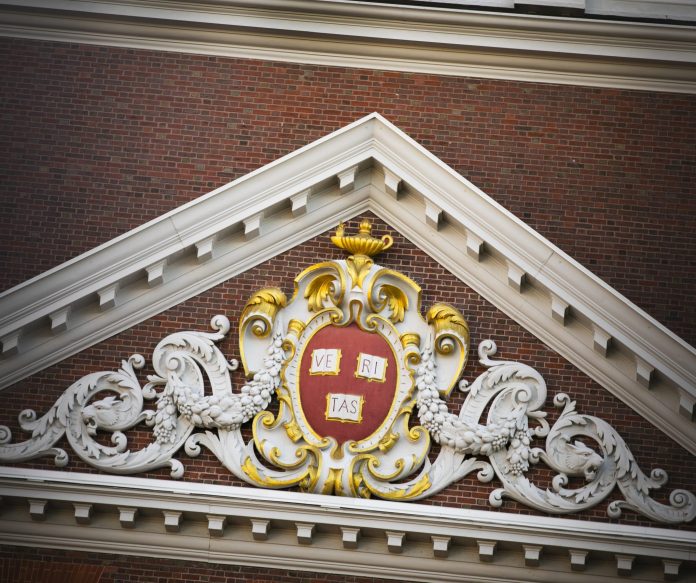
The Harvard Shield

On Sept. 8, 1836, at Harvard’s Bicentennial celebration, it was announced that President Josiah Quincy had found the first rough sketch of the College arms – a shield with the Latin motto “VERITAS” (“Verity” or “Truth”) on three books – while researching his History of Harvard University in the College Archives. During the Bicentennial, a white banner atop a large tent in the Yard publicly displayed this design for the first time. Until Quincy’s discovery, the hand-drawn sketch (from records of an Overseers meeting on Jan. 6, 1644) had been filed away and forgotten. It became the basis of the seal officially adopted by the Corporation in 1843 and still informs the version used today. *

Why Crimson?*

Crimson was officially designated as Harvard’s color by a vote of the Harvard Corporation in 1910. But why crimson? A pair of rowers, Charles W. Eliot, Class of 1853, and Benjamin W. Crowninshield, Class of 1858, provided crimson scarves to their teammates so that spectators could differentiate Harvard’s crew team from other teams during a regatta in 1858. Eliot became Harvard’s 21st president in 1869 and served until 1909; the Corporation vote to make the color of Eliot’s bandannas the official color came soon after he stepped down.

But before the official vote by the Harvard Corporation, students’ color of choice had at one point wavered between crimson and magenta – probably because the idea of using colors to represent universities was still new in the latter part of the 19th century. Pushed by popular debate to decide, Harvard undergraduates held a plebiscite on May 6, 1875, on the University’s color, and crimson won by a wide margin. The student newspaper – which had been called The Magenta – changed its name with the very next issue.

*U.S. Presidents and Honorary Degrees*

After George Washington’s Continental Army forced the British to leave Boston in March 1776, the Harvard Corporation and Overseers voted on April 3, 1776, to confer an honorary degree upon the general, who accepted it that very day (probably at his Cambridge headquarters in Craigie House). Washington next visited Harvard in 1789, as the first U.S. president. 

Other U.S. presidents to receive an honorary degree include:

1781  John Adams

1787  Thomas Jefferson

1822  John Quincy Adams

1833  Andrew Jackson

1872  Ulysses S. Grant

1905  William Howard Taft

1907  Woodrow Wilson

1917  Herbert Hoover

1919  Theodore Roosevelt

1929  Franklin Delano Roosevelt

1946  Dwight Eisenhower

1956  John F. Kennedy

  1. Soft Robots, in color
  2. Sir Alex leads the way
  3. Fareed Zakaria Commencement 2012 Speech
  4. Wonders of Wintersession
  5. Harvard serves up its own ‘Plate’
  6. 895 admitted through Early Action
  1. When a calorie is not just a calorie
  2. Sir Alex leads the way
  3. Text of J.K. Rowling’s speech
  4. 895 admitted through Early Action
  5. Soft Robots, in color
  6. Rapid acts of kindness
Great teachers
  • Harvard at a Glance
    • About the Faculty
    • Campus
    • Commencement
    • 375th Anniversary
    • History
      • Harvard Governance
      • Historical Facts
    • History of the Presidency
    • Honors
    • Student Life
  • FAQ
  • Academic Experience
  • Maps & Directions
  • Directories
  • Harvard's Leadership
  • Harvard's President
Harvard Yard Mobile App Tour

View all Harvard social

Connect with Harvard via:

Twitter

  • About 1 Hour Ago from @Harvard

    For a New Year filled with good health http://hvrd.me/10EMcNm (via @harvardhealth)

  • About 2 Hours Ago from @Harvard

    Cleaning up your computer desktop for the New Year? Download these calendar 2013 desktop wallpapers: http://hvrd.me/Vr4TNQ

  • About 2 Hours Ago from @GreenHarvard

    #Happy #NewYear! Let's look back on 2012 #green moments @Harvard and make 2013 even more sustainable - http://hvrd.me/T6P3fL

  • About 2 Hours Ago from @Harvard

    When a calorie is not just a calorie: Reducing refined carbs may help maintain weight loss better than reducing fat http://hvrd.me/Tutq7c

  • About 4 Hours Ago from @HarvardArts

    Happy New Year! Wishing you many arts @Harvard in 2013! http://ow.ly/gsOeI

  • About 4 Hours Ago from @HarvardAlumni

    2012 is history - what will the @Harvard community make history in 2013? http://ow.ly/gcp95

  • About 5 Hours Ago from @HarvardDASH

    Getting Told and Being Believed http://dlvr.it/2kP8PS #fas

  • About 5 Hours Ago from @HarvardDASH

    Judgements of the Lucky Across Development and Culture http://dlvr.it/2kP0nx #fas

  • About 6 Hours Ago from @Harvard

    Build your core muscles for a healthier, more active future http://hvrd.me/10rYVmt (via @harvardhealth)

Facebook

  • December 24, 2012 from Harvard

    Thanks to all of you (from India to Mexico, Brazil to the Philippines, and other countries around the world) for a great 2012 here on Read more…

  • December 23, 2012 from Harvard

    Researchers find that some black holes may be about ten times more massive than previously thought, weighing 40 billion times the mass of Read more…

View all Harvard mobile

Find Harvard on:

  • Facebook
  • Twitter
  • YouTube
  • RSS
  • iTunes U
  • Foursquare
  • Google Plus
  • StumbleUpon
Harvard University
Harvard University
Cambridge, MA 02138
617.495.1000 | Feedback
  • HarvardArts
  • HarvardScience
  • HarvardWorldwide
  • HarvardInTheCommunity
  • Trademark Notice
  • Report a Copyright Infringement
  • Report Security Issue
  • Privacy Statement
  • Accessibility
  • Sitemap
  • Contact Harvard

Copyright © 2013 The President and Fellows of Harvard College